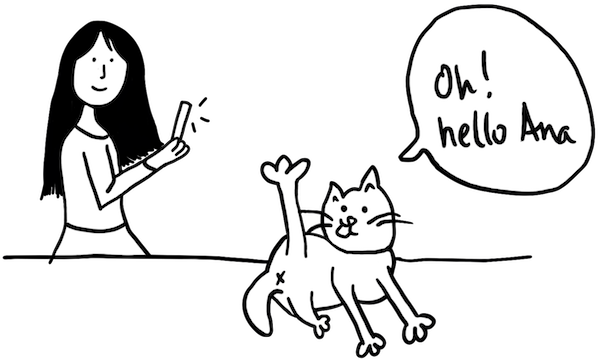
Last year I spoke at MK Geek Night about my personal reflections on how, after years of chasing IndieWeb perfection, I just accepted my imperfect website. I finally sat down to transcribe it and post it here. The base of this post was a transcript of my presentation but some editing is now present for added clarity, blog context instead of presentation and correction of grammatical mistakes.
This a ramble about what a safe personal online space focused on creativity, community, and self-expression could look like.
If you're attending a meet-up physically, you are, very likely, in a third-space.
In sociology, the third space refers to the social surroundings that are separate from the two usual social environments of home ("first place") and the workplace ("second place"). MKGN is a community. People here want to gather, interact, and build relationships. You may be looking at familiar faces you've seen in previous events.
How my personal website became my online third-space.
So I want to talk about how my personal website became my online third-space. Not a social media account, not a discord server, not a private slack channel, not a forum, not a Facebook group. Just my website. And by extension, how other people's personal websites are the same for me.
I built my first personal website over 20 years ago. Unfortunately, for me I have no other hobbies other than coding. I started developing small fan sites as a pre teen in the early 2000s and carried on as a career.
My home on the web is my blog. This website was originally created sometime in 2014 but in the past I've had multiple websites and blogs which thankfully are not online anymore because I was a child then and very immature as expected!
When I first began to draft this talk, I realised that I was stuck on how to build the story because I knew the end of it. The start is so muddy and long and my cognitive dissonance wasn't helping. So, in a slightly unorthodox strategy, I will start by sharing what one of my main takeaways is.
Everything takes time to build, understand, realise and appreciate.
What does it mean to have an online presence nowadays?
So I'm going to attempt to start with the basics. What does it mean to have an online presence nowadays? For the majority of people, to be online, or to have an online presence, is to have an account on a website owned by a corporation or by someone with too much money. We will have a personal account somewhere, a professional account elsewhere, perhaps a silly account in another place. Most people may rarely open their browser anymore.
We don't go "online" anymore or "surf the web".
We're always on.
Always on hold for a push notification.
We go from the big screen to the little screen and open the same four websites.
We go from the big screen on our desks to the little screen on our phones and back to those same websites.
Websites that have give you no transparency on how they use your data, no ownership, no privacy and no safeguards.
The landlords of the internet.
What does an online third space look like?
To most people, it may be one of those websites. Most likely a group they are part of inside of those internet walled gardens.
What does an online third space look like in 2025? Discord? Slack? A Facebook group? A Twitch stream?
What did an online third space look like in the past? A phpbb forum? A live journal account? An old chatroom?
Regardless of the tools/companies mentioned when answering these questions, they all seem to have something in common: A community to participate in.
But the other thing I kept coming to my head was also a place to wander around.
When it all began for me
In 2017, I was feeling a frustration that I couldn't explain. Tech twitter was at his peak and my interest in Facebook was long gone. Instagram was still bearable, snapchat was the king and I had forgotten I had a LinkedIn account. I remember feeling stressed that I wasn't keeping up with all the tech posts from the cool people in tech in twitter. Tech fomo was real. I had a blog but who the hell was I to even dare to blog something technical, I thought. I missed the old web. I had nostalgia. The current web experience gave me anxiety and brought up all my insecurities.
I went to a conference and I learned about the IndieWeb community from a talk by Jeremy Keith called "Building Blocks of the Indie Web". And at the time it spoke to me on a deep level because I had always been the type of person who was keen on learning and sharing in public about code during my teenage years but had stopped ever since I started to work professionally as a developer. And in 2017, my new blog was only 3 years old.
From that talk I learned about the HWC, under the IndieWeb umbrella, is a regular meet-up of people passionate about or interested in creating, improving, building, designing their own website. And one evening, sometime in either 2017 or 2018, I turned up to one meet-up and I'm so glad I did because I wouldn't be here today if I hadn't. Later on, I became one of the organisers.
And found myself the following year, on the same stage as Jeremy Keith, sharing my frustration on how I wished the front-end community would blog more and tried to encourage people to do it. My arguments were simple: the moment a social media is gone, all your content is gone. You should own it. Little did I know then that I would be proved right by Elon killing twitter as we knew it.
I was ranting about how we blog so little nowadays, but in 2018 I had less than 20 posts in a four year old blog. That's five blog posts a year roughly. The irony.
So who is this IndieWeb?
"The IndieWeb community is about creating or improving your personal website while also helping others to build theirs, either by documenting or creating tools."
"To help create an alternative to the corporate web, members of the IndieWeb community have built tools that anyone can use on their personal website that helps create the interaction and community building between personal websites."
What does "people-focused" alternative to the "corporate web" mean?
The IndieWeb community believes that you should own your content and an option for that is to have your content and interactions first posted on your personal website and then shared on other platforms.
Things like your articles, status, images, likes, comments etc would forever be in your ownership, with a permanent link and you can keep a record of it forever in case any platform/social media is deleted or you're banned.
And it can look something like this.
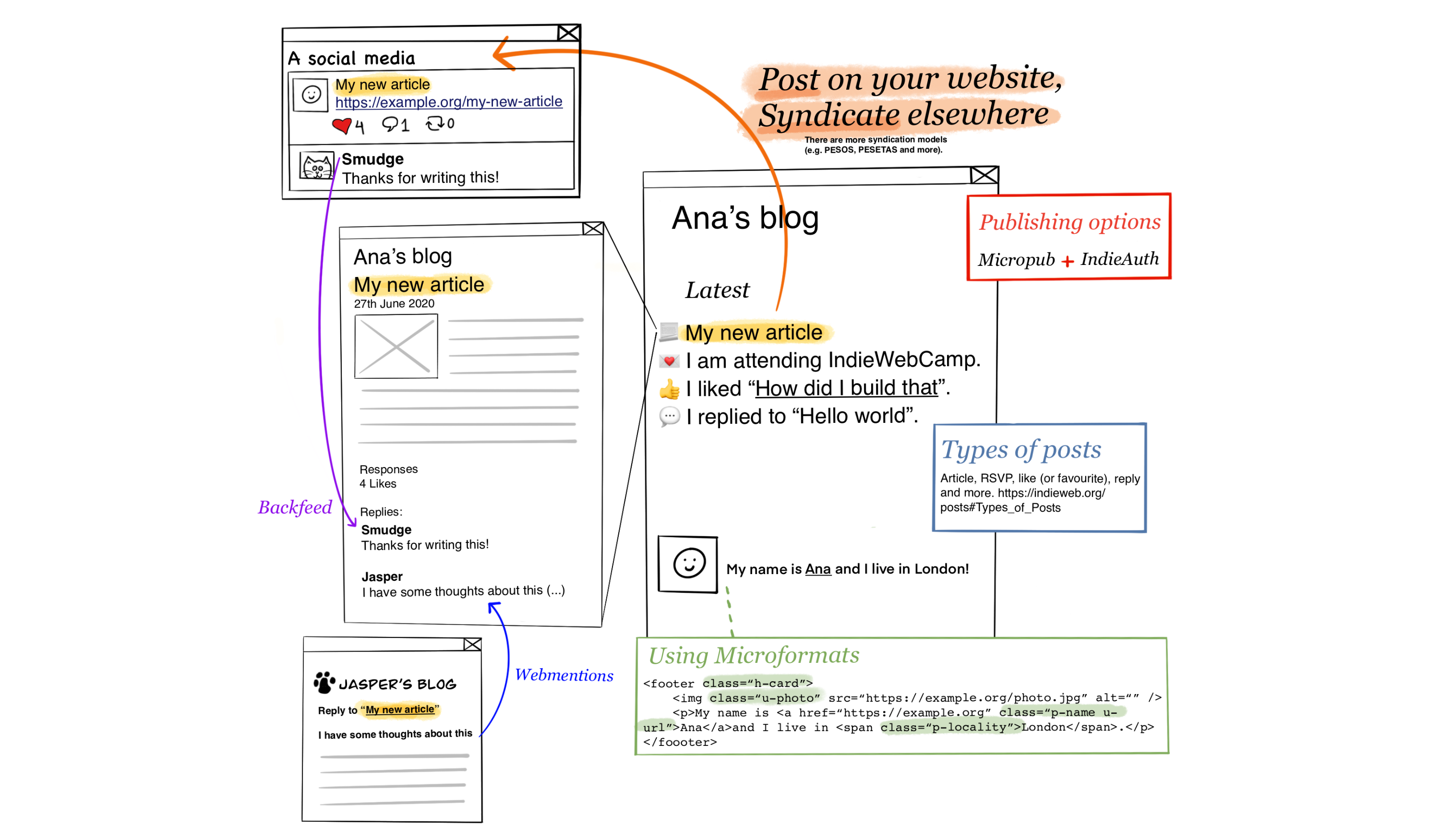
This diagram? I did for an article about the IndieWeb for Smashing Magazine. In it I went a bit into more detail on a few tech bits but the reality is I don't even implement the stuff I mentioned.
The boxes were ticked but something was missing
✅ I was part of a community.
✅ I was satisfied with "the content"
It's 2020, the cursed year, and I am writing more frequently on my blog.
I wasn't necessarily producing a lot of original content, but creating round-up of links, small meta posts and writing and talking about the IndieWeb which made me happy.
I was on the right track but something was missing.
Problem 1 - I was overwhelmed and I didn't notice it.
No one was putting pressure on me but my blog felt like a chore.
I wanted to do all the things my IndieWeb peers had but I either just didn't have the time or the skills. I wanted to blog more but didn't know what about. At the time, my blog was just a list of blog posts.
I was constantly feeling behind unnecessarily.
When I first started to participate in the community and attend their meet-ups and camps, I created this unnecessary pressure on myself to do and use all the protocols and apis suggested in order to create a full "social" experience from my website to corporate silos. So I had to take a big step back.
You don't have to over-engineer.
I've been saying since 2018 that "my goal is to create my own micropub endpoint" and I end up only focusing on that and doing nothing else - to little success to this date. And I believe this is what stops a few people from fully embracing the fact that they too are keen on the community. Like myself in the past, there's a lot of people who may fear that you're only a real IndieWeb person if you build it all.
As lame as it is, I'm going to once again quote myself:
"I am not less than the other people in the IndieWeb community for not having a fancy, automated, cool setup on my personal website. Nobody has ever made me feel that way. It doesn't matter if all you have is a simple page with your name and email."
A bit like turning a house into a home, I had to let go big ambitions and make the website cosy.
I re-designed it. I imagined what I would like my digital home to look like. I wanted sections to enter and explore. Like a digital garden. They are unfinished but the intention is there.
I let go of design trends and experimented even if the code is rough and "unprofessional".
Problem 2 - I forgot to "surf to web"
I was still stuck doom scrolling on places like Twitter. And to be fair, nowadays mostly Mastodon and Bluesky. But, still, I was going back to the same handful of hell websites.
So I carved out time to add other websites to my RSS reader.
Reading posts not limited by character limits, posts not engineered to be promoted by a algo, reading their long thoughts without hashtags. What a joy having to go beyond my bookmarks and blogrolls.
I forced time to manually visit other people's websites homes.
Either via webrings, blogrolls etc. Admiring other people's homes makes me want to work on mine. Not to keep up with them but because they inspired me. They made me admire humans. Explore little easter eggs. Truly pass time.
This meant that I added things like a guestbook to mine and signed others.
I took the time to tell someone that I thought their website was beautiful and brightened my day. And slowly I built "online friends". We started to respond to each other whenever we posted. Sometimes via email which is now the equivalent of receiving a nice postcard.
Problem 3 - I still had a vague online persona
Many of my past decisions were based on having a professional persona. I had this rule of sandwiching a personal post in the middle of technical posts. This is a thought caused my our horrible capitalist landscape where you make yourself a product.
So I stopped saying: "I am a front-end developer" to: "I work as a front-end developer" And applied these changes all over my website and social media bios.
Turns out my most engaging posts are my personal posts.
These led to more deep connections, more caring emails from readers and new friendships blossoming. Things like my miscarriage, my dad passing away, the brutality of the pandemic and brexit etc.
I want my personal website to be like visiting my living room in my home.
Come hang out with me. Look at my bookshelf.
On my personal website I can experiment, share, delete and moderate as I wish. It's my comfort zone.
I don't need to see analytics, engagement (or lack of), number of likes, comments or whatever I don't want to.
It's now 2025 and my website is a constant work in progress but it is now where I have joy spending time at.
Everything takes time to build, understand, realise and appreciate.
It is now 10 years of archives that are findable, that I can link to even on this talk, that I can quote myself, that I can browse and relive memories, that I now have a better understanding of my goals with it and I can change those goals too. If in 2015 I had deleted the whole thing I wouldn't have appreciated it. You couldn't make me delete it now.
"Sure ana, you took 10 years to probably reap the benefits of a personal website and blog".
Well.. time will pass anyways.
What else can I tell you?
"I have no content to put on a personal website"
That's not true.
- It shouldn't be the point
- The goal of a personal website is to be reachable. Your content might just be your name and your contact information. And that's fine. And you can change your mind anytime.
You don't have to be a content creator to have a website.
Not long ago, Paul Robert Lloyd shared a presentation that is a beginner's guide to the IndieWeb and made it all available on his website - truly living the IndieWeb spirit! And I really recommend it as it goes a bit into more technical detail and shares some ideas in detail.
The indie/small/cosy/fun/personal/whimsical web isn't gone. You're just not going to find it on Instagram/X/LinkedIn/Facebook/Reddit etc.
Join whatever community or safe place that feels better for you - all we can wish for is that you find some time to embrace creating your personal website.
Also posted on IndieNews